
Common Concrete Surface Problems and Prevention
Concrete starts life as a chemical reaction in outdoor weather, not a factory-made tile. Knowing why surface defects like plastic shrinkage cracking, dusting or delamination happen helps property owners and builders spot good trade habits—and look after fresh slabs properly.
Key takeaways
- ✓Control joints do not stop concrete from shrinking; they guide natural drying contraction into straight, tidy lines.
- ✓Never add unapproved extra water on site just to make concrete easier to rake—excess water weakens paste and causes surface dusting.
- ✓Finishing too early while bleed water sits on top traps moisture and leads to flaking or blistering.
- ✓Keeping fresh concrete damp or sealed during its first week dramatically improves surface hardness and abrasion resistance.
1. Plastic shrinkage vs drying shrinkage cracks
Two distinct mechanisms cause early cracking. Plastic shrinkage cracks appear within hours of placement when hot sun or dry wind evaporates surface moisture faster than bleed water rises from below. Evaporation retarders (aliphatic alcohol sprays), windbreaks and prompt curing prevent the surface skin from tearing while still plastic.
Drying shrinkage occurs over weeks and months as hardened concrete loses excess mix water and contracts slightly. Because friction and corners restrain that contraction, concreters install tooled or saw-cut control joints—typically to at least a quarter of the slab depth at sensible bay ratios—and place isolation foam against fixed walls, columns and drainage pits.
2. Surface dusting and weak paste
A powdery surface that chalks under broom sweeping or tyres ("dusting") is most often caused by adding excessive water at the truck chute, sprinkling water onto the surface during trowelling ("blessing" the slab), or poor curing that lets hydration stall prematurely.
Ordering the right slump or using batch-plant water-reducing admixtures achieves workability without diluting the water-to-cement ratio at the wearing surface.
3. Blistering, flaking and premature steel trowelling
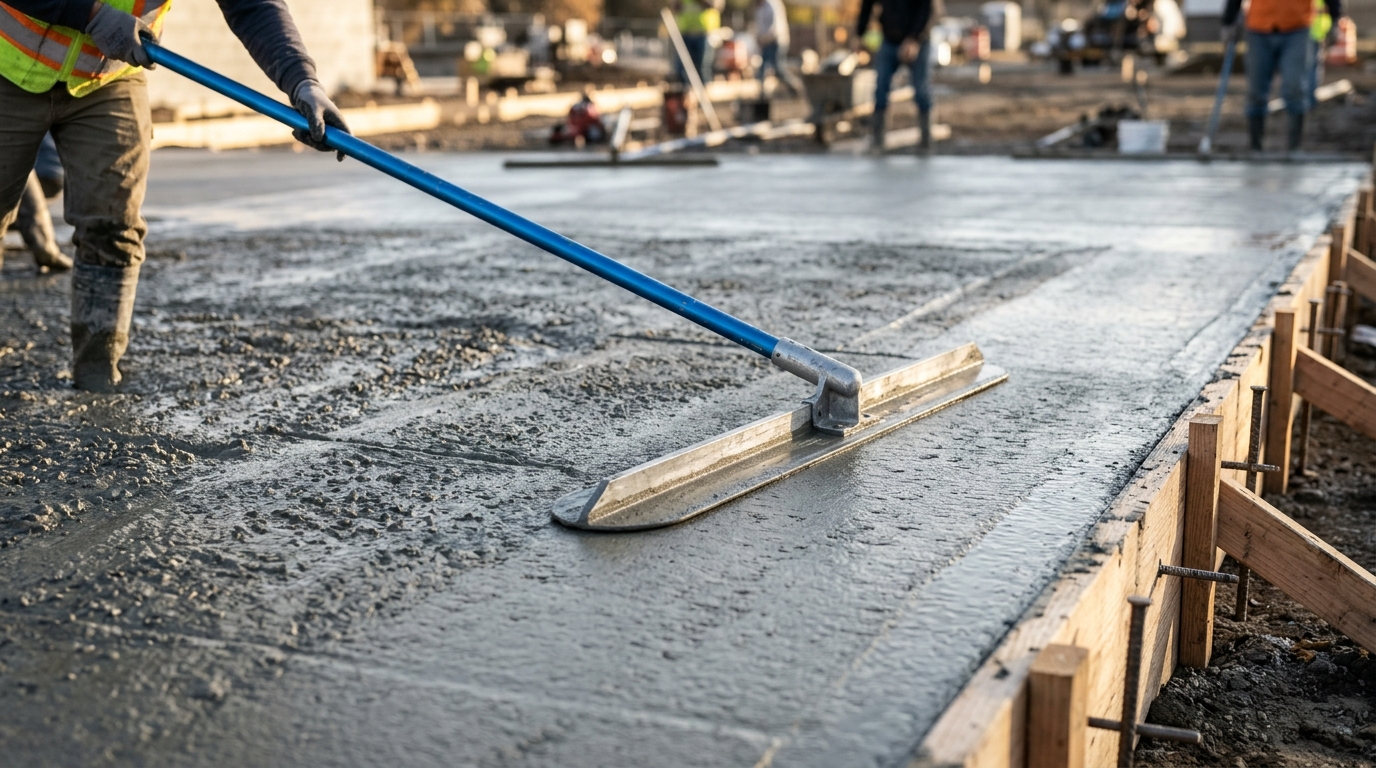
Freshly placed concrete naturally releases bleed water upward as heavy aggregates settle. Closing the surface tight with steel trowels before bleeding finishes traps water and air pockets just millimetres beneath a dense crust—which later pops off under tyres or foot traffic as delamination.
Patient timing—bull-floating initially, waiting for bleed water sheen to evaporate, and matching finish tools to the concrete mix—keeps the wearing layer monolithically bonded.
4. Curing and first-month care
Cement gains strength and surface density through chemical hydration, which requires moisture. Allowing a thin patio or driveway to bake bone-dry the day after pouring leaves the top few millimetres weaker than its potential.
- Follow curing instructions—whether wet misting, polythene cover or spray-applied curing/sealing compounds compatible with future floor coverings.
- Avoid parking vehicles, twisting front steering wheels on the spot, or stacking heavy brick pallets on fresh residential pavements during early curing.
- Avoid high-pressure water blasters close to green concrete during the first month, and keep flexible joint sealants maintained over time.
Frequently asked questions
Are hairline crazing patterns a structural failure?+
Fine, shallow map-like surface crazing only penetrates the very top cement paste skin and rarely affects structural capacity, though good curing and avoiding surface water sprinkling help minimise its appearance.
Can floor tiles or vinyl be laid over any spray-on concrete curing compound?+
Not always! Wax- or hydrocarbon-based curing compounds can block tile adhesives, levelling compounds and epoxy coatings. Internal slabs receiving stick-down flooring must either be water-cured or treated only with confirmed compatible/removable systems.
References & Australian industry guidance
General educational summary only. Always consult a qualified structural engineer, geotechnical practitioner or local building authority for site-specific compliance.
- Concrete Basics & Plastic / Drying Shrinkage Cracking Datasheets ↗ — Cement Concrete & Aggregates Australia (CCAA)
Authoritative Australian industry datasheets detailing causes and prevention of plastic cracking, dusting, crazing and delamination.
- AS 3600 Scope Overview — Concrete Structures (Curing & Durability Principles) ↗ — Standards Australia
Australian Standard covering durability exposure classifications, strength grades and curing requirements for structural concrete.